#3: YOUR FINANCIAL ADVISOR
November 12, 2015
The value of Time and Money
December 11, 2017
Over the last couple of years, we have witnessed tears and euphoria with the markets bouncing around, but why all the fuss? We have had numerous phone calls from clients suggesting that the market might be in a downward spiral and that we should rather withdraw now and save what is left after an 8% ‘correction’. Now, I would have given this statement some consideration was it not for the fact that the average age of these clients were about 35. More alarming than the previous statement was what came thereafter.
“I don’t think my current adviser is managing my portfolio correctly as it is not performing as I expected. Can you help me in choosing different funds to improve the growth in a portfolio?” I asked the prospective client to send me a statement of his current investment. To my surprise, I saw very much the same type of funds that I would have chosen for the age and risk profile that he described to me. I then calculated the IRR for the investment period and wasn’t too shocked to find an 8,2% return for the previous twelve months. I kept calm and proceeded to ask him what his expectation was of his portfolio. “Well, I understand that the portfolio is not aggressively invested in equities, so I would be happy with about 12% per year.” I gave a rather audible sigh.
 I then realised that quite a few advisers are actually very good at investing their clients’ capital, but they are losing clients because of a lack of one key ingredient: managing the client’s expectations. I mean, it is human nature to be anxious in turbulent times and wanting to save face before everything collapses into a pile of dust. That’s just how we were put together. However, now that we have had a few years of very strong market performance, everybody became complacent with portfolio growth of over Inflation + 5% in a Medium Risk Portfolio. And this included some financial advisers.
I had a long talk with an ex-colleague a while ago and he explained how he managed his clients’ expectations in volatile markets. I tweaked it here and there, but the main idea was just so brilliantly simple that I had to share.
“Firstly, Mr Client, has anything changed in your life the last week? What in your life changed so drastically that we have to alter your 20 to 30-year investment plan, just because of a market correction?” As a financial adviser, when planning on how to reach your financial goals, it would be rather foolish to ignore possible market corrections. The key here is that the only circumstances that should influence your investment plan are changes in your lifestyle. That is why it is critically important to review this plan on an annual basis.
“But I’ve lost a lot of money…” is then a common reply. But did you really?
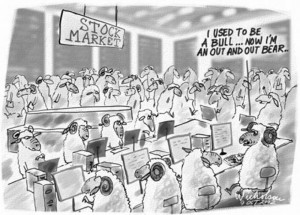
Here is where the concept of realising your losses comes in. The crux is that you actually only ‘lost money’ when you realise that loss into cash. Let’s simplify that statement. Picture a sheep farmer. He went to the market and bought 1000 sheep for R1000 per sheep. After transporting them to his farm and letting them out to graze, he goes to his ‘accounting book’ and notes his 1000 units of livestock bought for R1000 per unit, that equals a total value of livestock of R 1 000 000. Now, a month later, he goes to the market and finds out that the price per sheep has fallen to R900 per sheep if he would want to sell them today. He then makes a quick calculation and realises that his livestock is now worth 1000 X R900 = R 900 000. He then makes the statement “Oh no! I’ve lost R 100 000 worth of sheep! I must sell all my sheep before I lose more!”
Do you think that makes sense? The amount of sheep grazing along merrily on the farm is still 1000, isn’t it? The amount of wool that those sheep are providing is still the same, the amount of meat is still increasing and, given enough time, the value of the sheep is still going to be the same or higher. Any farmer knows this and that is why they will never make a statement like the one I quoted above. It’s just not rational.
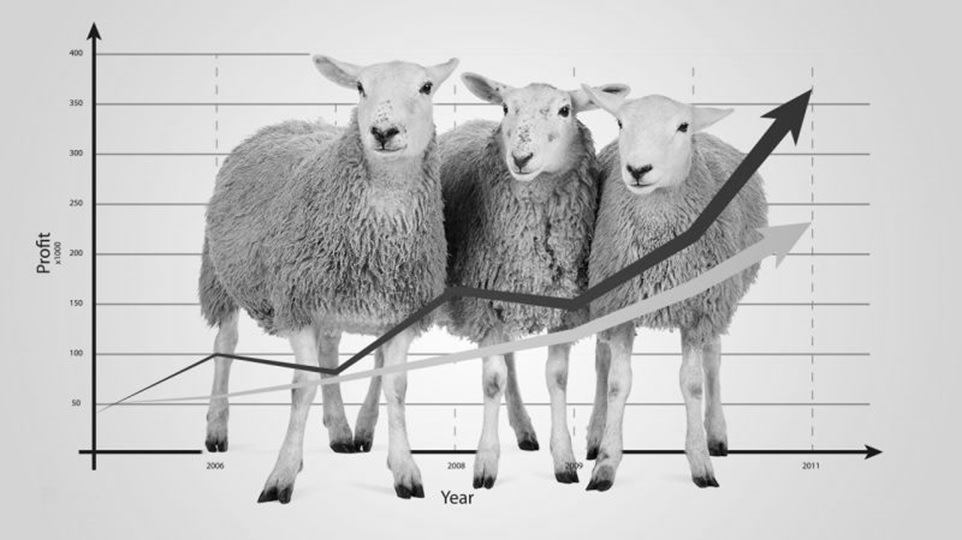 Now, consider if investing in Unit Trusts are any different? You own units of a fund that is invested in different asset classes. Every unit = one sheep. These units then vary in value over time as the markets for the different asset classes move up or down. The units still provide dividends and interest like a sheep provides wool. Just because the value of the units decreased does not mean that you lost any units or ‘money’. It’s just the value that decreased. The key here is the investment horizon you are looking at and the goal you need to accomplish with the specific investment. Any investment with a horizon of more than 10 years (historically this figure is actually 7 years, but I am very cautious in nature) could be invested over 75% in shares and should be able to recover any losses over the period.
So, to recap, what should you as the client look out for in the future when the markets go belly-up?
- Your investments are put into place with a specific plan and goals in mind. What the market does should have no influence on any investment plan, especially not one with an investment horizon of 10 years or more.
- I know it’s hard sometimes, but stick out the bad times to be able to profit from the good times. There is only one type of loss and that is a realised loss.
- The focus of your portfolio should be consistent, targeted performance, not shooting the lights out one year and falling into the mud the next. Managing your expectation is key here.
- It’s always good to keep informed, so ask your financial adviser about what he/she thinks.
Happy investing!